
What Is AI Automation?
The operationalization of artificial intelligence for the execution of tasks decisions and workflows heretofore necessitating manual human intervention constitutes the definitional essence of AI automation. However a critical distinction demands early comprehension as the compound term bifurcates into two constituent conceptualizations. Automation denotes the deployment of software in strict accordance with prespecified rules for the accomplishment of routine work absent continuous human supervision. AI contributes the capacities for language comprehension pattern recognition and the rendering of judgment calls. It is crucial to note that the differentiation manifests with particular clarity within the inbox environment wherein basic automation effects the transmission of identical canned replies to every customer without discrimination whereas AI automation undertakes the perusal of each individual message ascertains the substantive requirement of the correspondent and undertakes the composition of a reply calibrated to the identified need. The technology demonstrates maximal utility in operational contexts characterized by variation such as disorganized emails documents manifesting in heterogeneous formats and interrogatives articulated through manifold phrasings. Moreover the reader encounters instantiations of this technological paradigm in quotidian digital existence through spam filters chatbots and recommendation feeds. A personal observational datum merits inclusion as the initial accurate algorithmic categorization of a disordered inbox occasioned a notable cognitive impression regarding the capabilities under discussion. This guide undertakes the exposition of the definitional parameters the presentation of real examples and the facilitation of the reader’s inaugural automation implementation.
AI Automation vs Traditional Automation
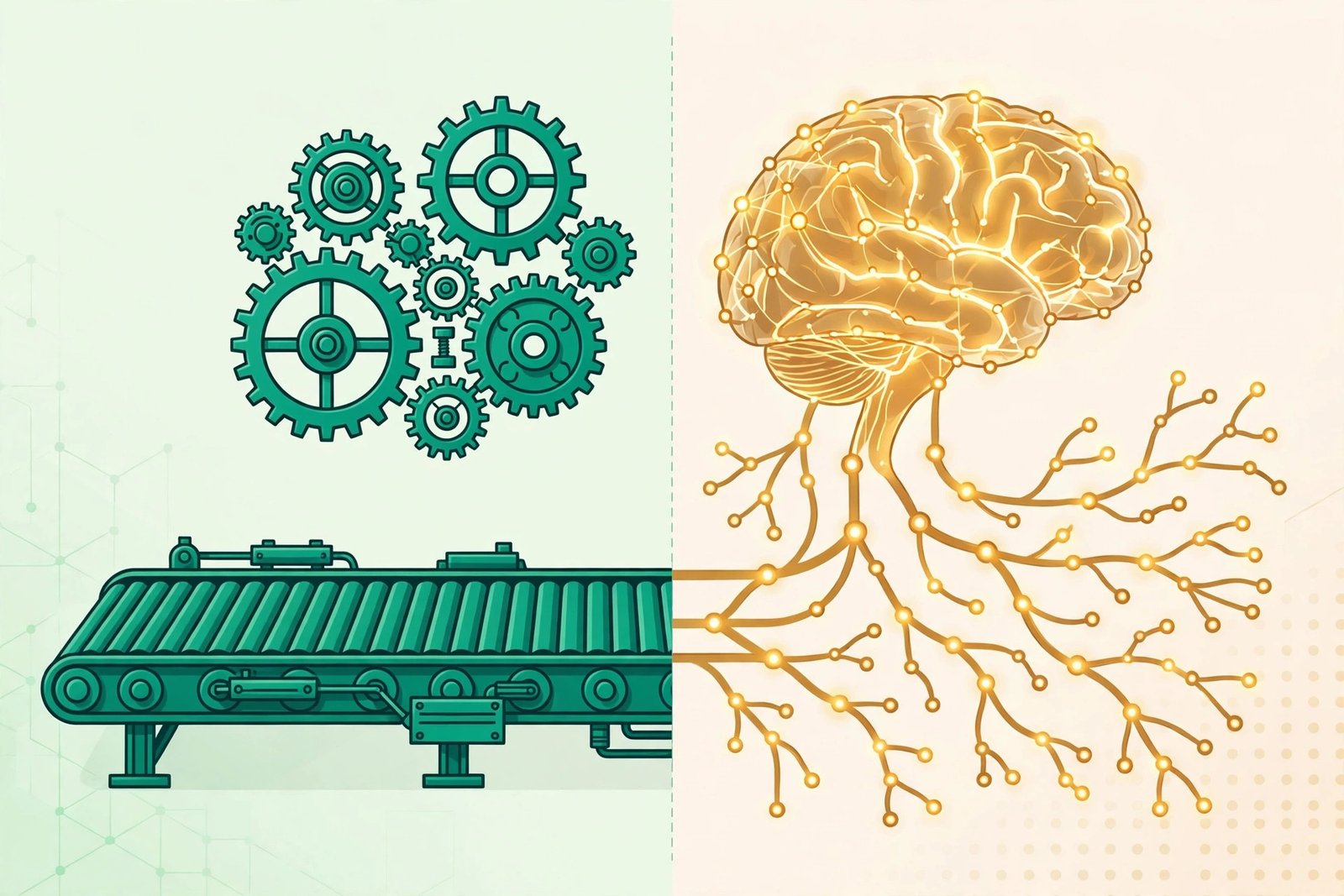
Both traditional automation and AI automation effectuate the elimination of manual work however a critical distinction demands early comprehension regarding their divergent decisional modalities. Traditional automation adheres to stringent if-this-then-that rules formulated by human operators and demonstrates reliability exclusively within fixed boundaries exemplified by the issuance of a receipt subsequent to each payment the publication of a scheduled update and the transcription of form entries into a spreadsheet. AI automation undertakes the interpretation of data the recognition of patterns and the adaptation of its behavior contingent upon fluctuations in inputs. It is crucial to note that the system reads meaning rather than mere keywords thereby accommodating language images and judgment-like choices. The two paradigms function as complements rather than rivals and the optimal deployment retains elementary rules for predictable tasks while introducing AI at junctures necessitating interpretation. Beginners characteristically encounter traditional automation initially through email filters and scheduled posts subsequently graduating to AI-augmented approaches upon the failure of rigid rules. An experiential annotation is warranted as an initial attempt at the categorization of client inquiries through keyword filtration resulted in the misclassification of approximately half the corpus whereas an AI classifier rectified the deficiency within a single afternoon.
| Traditional Automation | AI Automation | |
|---|---|---|
| How it decides | Follows fixed rules set by a person | Learns from data and interprets context |
| Flexibility | Breaks when inputs vary | Adapts to new and messy inputs |
| What it handles | Structured, predictable data | Language, images, and judgment-like choices |
| Setup effort | Simple; define the rule once | Needs examples and testing to tune |
| Best for | Repetitive tasks that never change | Varied work needing understanding |
| Cost to start | Usually free or cheap | Free tiers available; scales with use |
How Traditional Automation Works
Traditional automation operates through the mechanism of triggers wherein the occurrence of condition X necessitates the execution of action Y. A novel form submission generates a corresponding spreadsheet row while a completed payment initiates the dispatch of a receipt email and a calendar event precipitates a reminder. Its merits encompass predictability minimal expenditure and implementation within minutes absent any requirement for training data. Its limitation resides in literal-mindedness as the system matches keywords and exact conditions with the consequence that a correspondent articulating access difficulties through nonstandard phrasing evades the filtration apparatus. Deployment remains advisable in all operational contexts wherein the task manifests genuine invariability.
What AI Adds to the Mix
AI superimposes four distinct capabilities upon the automation substrate. Machine learning facilitates amelioration through data accumulation while natural language processing enables the understanding of text and computer vision permits the interpretation of images and predictive analytics generates outcome forecasts. Contemporary AI agents extend these capacities through the planning of multi-step undertakings and the execution of actions across heterogeneous tools within operator-defined guardrails. The practical dividend materializes in the accommodation of disordered real-world inputs encompassing free-text messages scanned documents and photographic reproductions of receipts. It is crucial to note that human oversight retains its position within the decisional loop at all junctures of material consequence which constitutes the prescribed operational posture for prudent beginners.
How AI Automation Actually Works
AI automation functions as a continuous loop comprising four sequential stages. The initial stage encompasses the reading of information from the tools constituting the existing operational environment. The subsequent stage involves the understanding of the acquired information and the formulation of decisions regarding appropriate responsive measures. The third stage executes the taking of action across the workflow frequently spanning multiple applications simultaneously. The terminal stage undertakes learning from observed results with progressive augmentation of acuity proportional to the accumulation of examples. It is crucial to note that the setup phase never attains true finality as the loop maintains perpetual rotation. For the preservation of concreteness a singular illustrative scenario shall accompany the four subordinate sections namely an inbox assistant undertaking the sorting of customer messages on behalf of a modest online store.
It Reads Information From Your Tools
All implementations originate in the establishment of connection. The automation integrates with email web forms spreadsheets chat applications and calendars constituting the loci of preexisting work activity. Its raw material encompasses incoming messages form submissions invoices support tickets and calendar events. Beginners face no requirement for the coding of these connections as no-code platforms provision prebuilt connectors activatable through elementary clicks. However a critical distinction demands early comprehension regarding a caution derived from operational experience. The verification of current plan limits must precede any construction effort since the permissible quantity of connected applications and monthly runs under free tiers undergoes frequent modification.
It Understands and Makes Decisions
Subsequent to the establishment of connectivity the AI undertakes the perusal of each item and the rendering of decisions concerning its proper classification. A message inquiring after order whereabouts receives classification as a shipping question while a notification of damaged merchandise attains the status of an urgent complaint. The system operates through calibrated confidence levels wherein cases of high certainty undergo automatic handling and instances of ambiguity or sensitivity receive flagging for human adjudication. An invoice reader executes an analogous procedure extracting the vendor name amount and due date from radically divergent layouts while flagging totals that fail to reconcile. The aforementioned inbox assistant would effectuate the segregation of refund requests product questions and spam into discrete receptacles prior to any human exertion.
It Takes Action Across Your Workflow
Decisions undergo transmutation into action. The system possesses the capacity for the drafting of replies the generation of support tickets the updating of spreadsheets the scheduling of follow-ups and the notification of teams through chat channels. A singular trigger frequently initiates a chain of operations across multiple applications such that a refund request simultaneously materializes as a ticket a draft apology and a warehouse notification in one unified motion. It is crucial to note that beginners must interpose approval gates before all irreversible operations encompassing refunds public posts deletions and payments. The inbox assistant under discussion for instance undertakes the drafting of replies while withholding transmission pending manual authorization. This singular procedural habit preempts nearly every documented automation catastrophe within the author’s observational purview.
It Learns and Improves Over Time
This stage marks the decisive divergence of AI automation from traditional automation. Every correction administered by the operator transforms into a training signal such that the accurate reclassification of three misclassified messages yields a measurably smarter sorter. Traditional automation attains no amelioration absent human reprogramming whereas AI systems undertake self-refinement derived from observed outcomes. However a critical distinction demands early comprehension concerning the pace of improvement. The learning process necessitates substantial volume and quality examples with the consequence that modest personal setups exhibit gradual advancement. Such gradualism warrants no concern. Even modest gains demonstrate compounding effects as an assistant managing sixty percent of routine sorting nevertheless restores hours of operator time on a monthly basis.
Real-World Examples of AI Automation
The reader in all probability engages with AI automation on a daily basis absent conscious recognition. The technology undertakes the filtration of spam the recommendation of subsequent video content and the completion of search queries. The identical technological substrate scales from personal convenience to substantive business application. The examples enumerated below progress from organizational contexts to the individual workstation ensuring the provision of familiar reference points for every reader. Each instantiation adheres to the previously explicated loop of reading understanding acting and learning.
Customer Support and Chatbots
Customer support constitutes the domain wherein the majority of observers first witness AI automation in operation. Chatbots deliver instantaneous responses to recurrent inquiries at all hours encompassing order status return policies and booking modifications. In the operational background AI undertakes the drafting of replies for human agents the summarization of protracted conversation histories ensuring informed agent engagement and the routing of tickets to appropriate specialized teams. The salubrious configuration reserves human personnel for sensitive matters. An irate customer or a billing dispute merits a human interlocutor rather than an algorithmic one. Deployed in this manner automation clears the routine queue thereby liberating human temporal resources for dialogues genuinely necessitating care.
Email and Message Management
The inbox represents the optimal experimental terrain for AI automation novices. The system sorts incoming mail according to topic and urgency drafts replies pending operator approval and summarizes threads that expanded to forty messages during the operator’s absence. For personnel managing inquiries the technology logs new leads dispatches timely first responses and issues reminders before follow-ups lapse into neglect. An observational datum from professional practice records a freelancer’s reduction of morning inbox triage from sixty minutes to fifteen through the combination of sorting rules and AI-generated drafts. Initiation within this domain delivers perceptible returns on the first day of deployment.
Marketing and Content Work
Marketing departments constituted early adopters owing to the repetitive and data-intensive character of their operations. AI executes audience segmentation based on behavioral signals rather than broadcasting undifferentiated messaging to entire lists. The system proposes send times and subject lines subsequently analyzing which combinations produced measurable efficacy. Regarding content production the technology drafts posts and electronic correspondence from concise briefs and repurposes singular articles into social media fragments. The non-negotiable procedural rule mandates human editorial review prior to any publication. AI generates drafts with velocity however the author’s voice and factual accuracy require human visual verification. The author’s own utilization of AI-generated drafts for content calendar construction followed by substantial rewriting confirms that the temporal economy derives from the starting point rather than the finished product.
Invoices and Document Processing
Financial departments exhibit particular enthusiasm for this application given the tediousness of the task and the costliness of errors. AI automation reads invoices and receipts manifesting in radically divergent formats and undertakes the extraction of vendor identity total amounts dates and tax figures subsequently transmitting cleansed data into accounting software. All discrepant items receive flagging for review rather than silent passage. Practitioners designate this an ideal inaugural project by virtue of its repetitive character its document-intensive nature and its ease of verification. The validation criterion attains elegant simplicity as the reconciliation of numbers signifies operational success.
Everyday Tasks You Can Automate
Organizational affiliation constitutes no prerequisite for the derivation of benefit. AI automation undertakes the summarization of meeting notes the transmutation of chat messages into reminders the logging of expenses from photographic reproductions of receipts and the compilation of morning digests concerning followed topics. Students may obtain summaries of recorded lectures while job seekers may track applications through automatic means. These personal automations necessitate neither budgetary allocation nor external permission. They furthermore constitute the safest pedagogical environment as operational errors exact a cost measured in minutes rather than customers.
The Main Benefits of AI Automation
The attractiveness of AI automation reduces to five practical dividends. The first concerns time as routine labor consuming weekly hours contracts to minutes of supervisory review. The second concerns accuracy as consistent execution diminishes fatigue-induced errors and missed follow-ups. The third concerns speed as customers and colleagues receive responses within minutes rather than days. The fourth concerns insight as the system discerns patterns within operational data that overburdened personnel would overlook such as the identification of inquiry characteristics predictive of conversion. The fifth concerns scale as a singular operator manages substantially expanded volume absent additional hiring. However a critical distinction demands early comprehension through an honest annotation that the technology augments personnel rather than supplanting judgment. The machinery absorbs the repetitive fractions of occupational roles thereby enlarging the human fractions. The author maintains deliberate modesty in these claims as the verifiable benefit of the first week reduces to the straightforward restitution of time.
Do You Need Technical Skills to Use AI Automation?
The direct interrogative warrants a direct negative response as coding constitutes no prerequisite. Contemporary no-code and low-code platforms enable the construction of automations through clicks dropdown menus and plain-language instructions. The no-code designation signifies visual workflow builders prebuilt app connectors and templates for recurrent tasks. The genuinely facilitative attribute is not programming proficiency but cognitive clarity encompassing the stepwise articulation of processes the maintenance of orderly data and the exercise of testing patience. The most accessible point of entry is an AI chat assistant itself as the plain-language description of a task yielding a structured result already constitutes automation thinking available for practice at zero cost. One honest boundary merits acknowledgment as sprawling multi-system implementations may ultimately necessitate developer intervention. Initiation at modest scale may ensure that such a threshold never materializes.
How Beginners Can Start With AI Automation
This section constitutes the culmination toward which the entire guide progresses namely the reader’s first automation constructed within the current week absent budgetary expenditure and coding requirements. The golden rule articulated by experienced practitioners attains elegant simplicity. The automation of one tedious frequent and checkable task must precede all expansion and subsequent growth should follow only upon the earning of operator trust. Elaborate strategic planning may await a later date. A singular reliable workflow surpasses five partially functional ones. The four steps enumerated below convey the reader from initial zero-state to operational automation.

Step 1: Pick One Repetitive Task
Judicious selection surpasses tool selection in determinative importance. Every candidate must undergo interrogation through three questions. Does the task occur often. Does it follow a discernible pattern. Does its output admit easy verification. Candidates satisfying all three criteria attain golden status encompassing the sorting of emails into folders the saving of attachments to cloud repositories the logging of expenses the posting of weekly reminders and the backing up of files. The inaugural project must exclude all irreversible legally sensitive or emotionally delicate operations. The author’s own initial selection was email sorting precisely because erroneous execution produced a misfiled message rather than a lost customer.
Step 2: Choose a Beginner-Friendly Tool
Tools distribute across three accessible categories. AI chat assistants undertake drafting summarization and ideation on demand. No-code automation platforms such as Zapier Make and n8n interconnect applications enabling inter-application data flow. Moreover the tools already in the reader’s possession accumulate built-in AI features including intelligent email replies automatic document summaries and self-composing spreadsheet formulas. The prescribed posture is universal commencement at free tiers. The majority of platforms provision free tiers of sufficient generosity for pedagogical purposes however the verification of current limitations on tasks and connected apps must precede commitment given the mutability of pricing pages.
Step 3: Build Your First Simple Automation
A concrete inaugural construction follows. Upon the starring of an email the system generates a task within the to-do list bearing the email’s subject as its title. The constituent micro-steps encompass the connection of email and task applications the designation of the star as the trigger the mapping of the subject line to the task title and the configuration of a notification upon execution. The majority of platforms offer one-click templates for precisely this pattern. Initiation from a template constitutes prudence rather than impropriety as professional practitioners employ this method routinely. The temporal expectation for the first construction including inevitable fumbling remains under thirty minutes.
Step 4: Test It and Keep a Human in the Loop
No nascent automation merits trust on its first day. Execution against sample data must precede the manual verification of five outputs and the rectification of erroneous field mappings which afflict every practitioner without exception. The maintenance of a human in the loop remains mandatory for all operations extending beyond operator control encompassing customer communications payments deletions and public posts. Weekly review during the initial period combined with the measurement of success through elementary before-and-after annotations of minutes saved constitutes proper stewardship. The addition of a second automation should follow only after the first demonstrates reliability across a fortnight. Deliberate trustworthiness invariably surpasses hasty unreliability.
Free vs Paid AI Automation Tools
Financial candor is warranted as the acquisition of knowledge and the operation of modest automations remain entirely achievable at free cost. Free tiers characteristically impose ceilings upon monthly tasks restrict premium app connectors and reduce the frequency of data polling. Such constraints nevertheless suffice for pedagogical purposes and personal utilization. Paid plans unlock elevated task volumes accelerated check intervals premium integrations and collaborative team functionalities. The disciplined methodology prescribes universal commencement at free levels with upgrades authorized exclusively when a free-tier limitation genuinely obstructs an already functional automation. The deliberate omission of specific prices reflects intentionality as pricing pages undergo mutation and readers should consult official pages for current figures prior to decisional commitment.
Common Beginner Mistakes to Avoid
Novice practitioners characteristically commit five recurrent mistakes. The first involves the automation of a disordered process as unclear manual workflows subjected to automation merely accelerate confusion mandating process rectification as the antecedent step. The second involves expectations of perfect accuracy as AI misinterprets ambiguous inputs which explains the existence of review steps for operations of consequence. The third involves the deployment of AI where elementary rules suffice as a plain email filter outperforms an AI classifier for exact-match scenarios at zero cost. The fourth involves the omission of human review for automatic customer transmissions and deletions. The fifth involves excessive simultaneous construction culminating in five partially functional automations. The author confesses personal commission of the third error having constructed an AI sorter for a problem that a two-line filter resolved superiorly.
What You Should Not Automate
Certain categories of work properly remain human and the discernment of this boundary constitutes an element of the skill itself. The automation of final decisions bearing material consequences warrants prohibition encompassing hiring determinations large payments lacking approval and all medical or legal determinations. The automation of sensitive human moments similarly warrants exclusion as distressed customers merit authentic care rather than templated responses. Operations defying verification must remain manual as unverifiable output constitutes liability rather than economy. Data stewardship imposes further constraints as passwords private customer records and confidential documents must never enter tools lacking proper vetting. The governing principle attains simplicity through the automation of routine operations thereby expanding human availability for work necessitating judgment.
Will AI Automation Take Your Job?
The honest response holds that AI automation transforms jobs with greater frequency than it eliminates them. Bundles of routine tasks contract while work demanding judgment relational capacity and accountability expands. Spreadsheets did not terminate the accounting profession but rather relocated accountants from arithmetic toward analytical functions. The identical pattern recurs in the present as personnel who master the direction of these tools augment rather than diminish their professional value. Occupational roles founded upon trust creativity and human presence retain maximal security. The practical hedge therefore consists not in apprehension of the technology but in its acquisition. Commencement through the four steps of this guide already positions the reader advantageously relative to the unfolding transformation.
FAQs About AI Automation
What is AI automation in simple words?
In maximally elementary formulation AI automation denotes software executing the reader’s repetitive digital work while rendering minor decisions throughout the process. Traditional automation resembles a timer sounding at 7 AM. AI automation resembles an assistant observing an early meeting on the calendar and independently advancing the alarm. The paradigm conjoins rule-adherent software with artificial intelligence comprehending language images and patterns.
How is AI automation different from normal automation?
Normal automation adheres to fixed rules of if-this-then-that construction admitting no exceptions. AI automation comprehends context and adapts amid changing circumstances. A normal auto-reply transmits identical messaging to every customer. An AI auto-reply peruses the customer’s articulated problem and drafts a calibrated response. The prescriptive allocation assigns normal automation to predictable repetition and AI automation to junctures requiring interpretation.
What are some common examples of AI automation?
Daily encounters encompass spam filters chatbots video recommendations and voice assistants. Professional contexts add email sorting invoice readers meeting summarizers lead follow-up sequences and support ticket routing. The unifying characteristic is software managing variation beyond the capacity of rigid rules.
Can small businesses and freelancers use AI automation?
The affirmative response carries an amplification as these operators frequently derive the greatest proportional benefit given the heightened value of each hour. Initiation requires a singular repeated task such as lead follow-ups invoice extraction review requests or appointment reminders. Built-in AI features and free tiers enable commencement on the present day absent budgetary allocation or technical personnel.
How much does AI automation cost?
The spectrum extends from free availability to monthly subscriptions contingent upon operational volume. Free tiers accommodate learning and light personal utilization. Paid plans exact charges for expanded monthly tasks accelerated update frequencies and premium connectors. The prescribed methodology is universal commencement at free levels with payment authorized only when a limitation obstructs a functional automation. Official pricing pages supply current figures.
What tasks should beginners automate first?
The three-question test governs selection. Does the task occur often. Does it follow a discernible pattern. Does its output admit easy verification. Robust inaugural candidates include sorting emails saving attachments logging expenses and the posting of reminders. Irreversible or sensitive operations must await the establishment of a reliable workflow.
Final Thoughts
AI automation at its conceptual core attains elegant simplicity as software assumes the repetitive fractions of work enabling human concentration upon the meaningful fractions. Readers whose days include repetitive digital labor should initiate immediately with one modest task and the four steps delineated in this guide. Readers presently unable to identify one repeatable task should defer initiation until such identification occurs as automation absent a target constitutes mere tinkering. The selection of today’s task the maintenance of a human in the loop and the gradual earning of machine trust one workflow at a time constitute the prescribed path forward.