
Open your phone and count the moments where a machine quietly guessed for you: the next song in the queue, a route that dodges traffic, the junk email that never reached your inbox. Behind each sits artificial intelligence, software that handles jobs we once assumed only human minds could do. It is already reshaping schools, hospitals, offices, and shops, so understanding it helps you use it wisely. This guide covers what AI is, how it works, its types, uses, benefits, risks, myths, history, and how to start learning.

What Is Artificial Intelligence?
Artificial intelligence is the effort to make computer systems act in ways that resemble human thinking: picking up skills from experience, noticing patterns, handling language, weighing options, and working through problems. These AI systems are not conscious. They crunch numbers at enormous scale, and the results happen to look like judgment. That is why some people prefer the label machine intelligence.
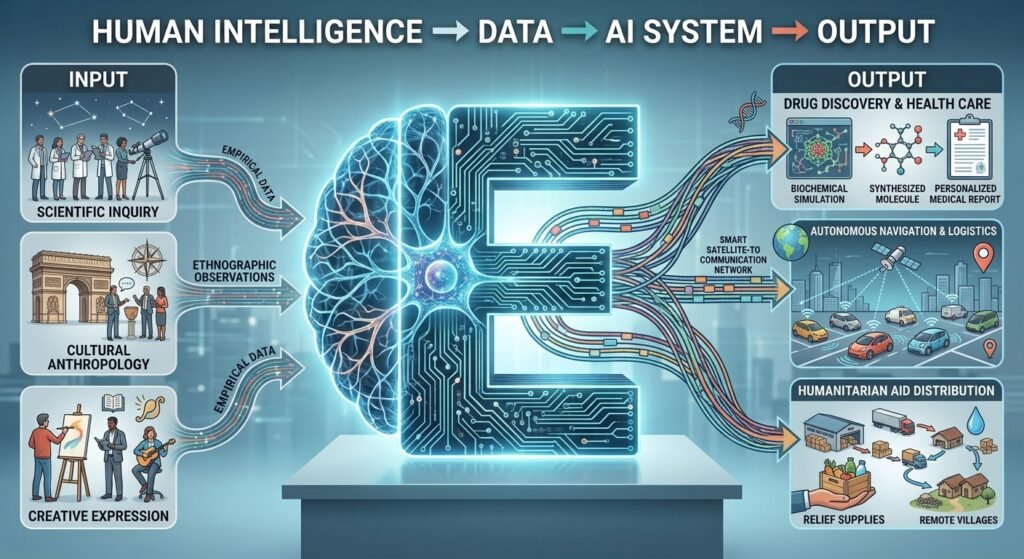
Artificial Intelligence Explained in Simple Terms
Imagine training a mail-sorting clerk with a thousand sorted letters instead of a manual. After enough examples, they begin to see which letters belong in which bin. AI learns much like that clerk: it studies plenty of examples, works out what they have in common, and then sorts fresh material on its own.
How Is AI Different From Traditional Computer Programs?
An ordinary program is a list of orders. If the input matches a rule, the program does what the programmer wrote, and nothing else. Many AI systems flip this around. Programmers supply examples and a learning method, and the system builds its own rules from the data. A system trained on labeled junk mail, for instance, can catch scam wording nobody predicted.
Examples of Artificial Intelligence in Everyday Life
You meet AI more often than you think. Search engines guess what you actually meant to look up. Streaming and shopping sites predict your next favorite. Voice assistants turn your speech into commands. Map apps forecast delays, and phone cameras find faces before you press the shutter.
How Does Artificial Intelligence Work?
Most AI projects move through the same stages: gather examples, choose a learning method, train a model, check its work on new material, and finally put it to use. Once running, the model turns whatever it receives into a prediction, a recommendation, a label, or a piece of generated text.

Data: What AI Learns From
Data is the study material. A training set might hold millions of photos, sentences, purchases, or sensor readings. Neatly organized tables count as structured data, while photos, recordings, and free-form writing count as unstructured. What matters most is quality. A model trained on patchy, outdated, or one-sided material will pick up those flaws.
Algorithms: How AI Finds Patterns
Think of an algorithm as the study technique. It is a defined series of steps for digging through data and spotting what repeats. In machine learning, the technique keeps refining itself with each new batch of examples.
Training an AI Model
The model is what remains after the technique has studied the data. Training works by trial and correction: the model guesses, gets compared with the right answer, and nudges its internal dials, known as parameters, to miss by a little less next time. Many models rely on neural networks, stacks of linked units loosely modeled on brain cells.
Testing and Improving AI Models
Before anyone trusts a model, it takes an exam using material it never saw during training. That reveals whether it truly learned or simply memorized. Poor scores send developers back to adjust settings or supply better data. Fine-tuning gives an existing model extra practice on a narrow subject.
How AI Generates an Answer or Prediction
Once trained, a model works in inference mode. You hand it something, say a leaf photo, it runs that input through what it learned, and it returns its best guess, such as the plant’s species.
What Are the Main Types of Artificial Intelligence?
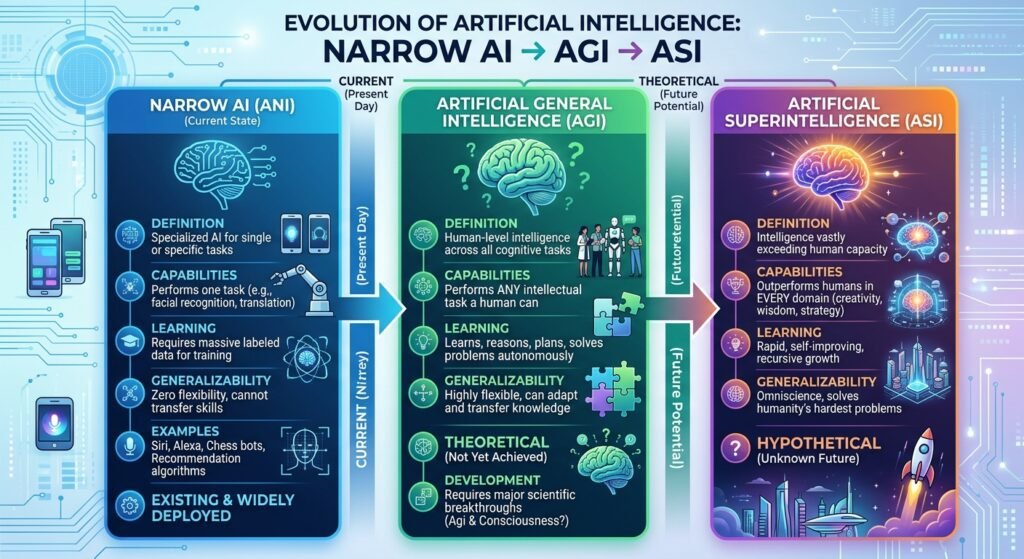
Experts sort AI in two ways: by how capable it is (narrow, general, and super) and by how it functions. Everything you can use today is narrow AI. The other two are ideas, not products.
Narrow AI (Weak AI)
Narrow AI, sometimes called weak AI, is built for one task or a small set of them. Voice assistants, translators, recommendation engines, and even the most impressive chatbots all live in this category.
Artificial General Intelligence (AGI)
AGI describes a system that could take on almost any mental task a person can and carry lessons from one area into another. It remains theoretical. Experts even disagree over how to define it and whether it is near or far away.
Artificial Superintelligence (ASI)
ASI goes further still: an imagined mind outperforming people at nearly everything, from science to art. It exists only in research debates and fiction. Some researchers cite it as a reason to prioritize AI safety.
AI Types Based on Functionality
Reactive machines see only the present moment and hold no memory; IBM’s chess-playing Deep Blue is the classic case. Limited-memory systems draw on recent or stored information, which covers nearly all modern AI. Theory of mind AI, able to grasp human feelings and intentions, has not been achieved.
What Is Machine Learning?
Machine learning (ML) is the branch of AI where computers work out the rules on their own by studying data. Instead of describing fraud to a computer, you show it countless honest and dishonest transactions and let it discover the difference. Because it improves with more examples, ML drives recommendations, translation, image recognition, and fraud detection.

How Machine Learning Works
The loop goes: collect data, train the model, let it absorb the patterns, test it on unseen examples, then use it for predictions. Weak results send the team back around with better data.
Supervised Learning
Here the training examples come with answers attached, like a workbook with an answer key at the back. Classification puts items in categories, for instance flagging a message as spam. Regression predicts a number, such as what a house might sell for.
Unsupervised Learning
With no answer key, the model explores on its own and looks for natural groupings. A shop could use clustering to discover groups of customers with similar habits, without deciding the categories beforehand.
Reinforcement Learning
This style is learning by doing. An AI agent acts inside an environment, earns rewards for good moves and penalties for bad ones, and gradually favors whatever pays off. It suits games, robot control, and other step-by-step decisions.
AI vs. Machine Learning
AI is the destination, and machine learning is one road there. Every ML system counts as AI, yet some early AI ran on hand-written logic with no learning at all.
What Is Deep Learning?
Deep learning is machine learning built on neural networks with many stacked layers. It shines when patterns are intricate and data is abundant, especially with images, sound, and text.
How Deep Learning Works
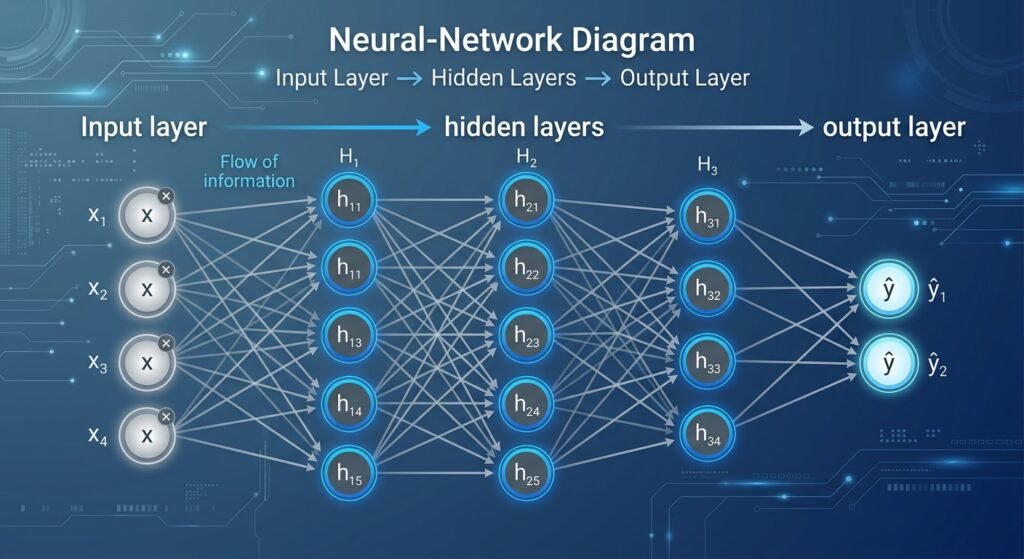
Information flows through the layers in sequence. The first layers pick up crude details such as edges, the middle ones assemble them into shapes like eyes, and the final ones recognize an entire face. The network works out these features itself, though it demands heavy data and computing power.
Neural Networks Explained for Beginners
Picture a line of coworkers passing along a note, each tweaking it before handing it on. A neural network has three parts: an input layer that takes in raw data, hidden layers that spot and combine patterns, and an output layer that announces the answer, like “cat” or “dog.”
Deep Learning vs. Machine Learning
Deep learning sits inside machine learning. Classic ML methods often do well on smaller, tidy datasets, with humans choosing what to measure. Deep learning handles raw, messy input but needs far more data and hardware.
What Is Generative AI?
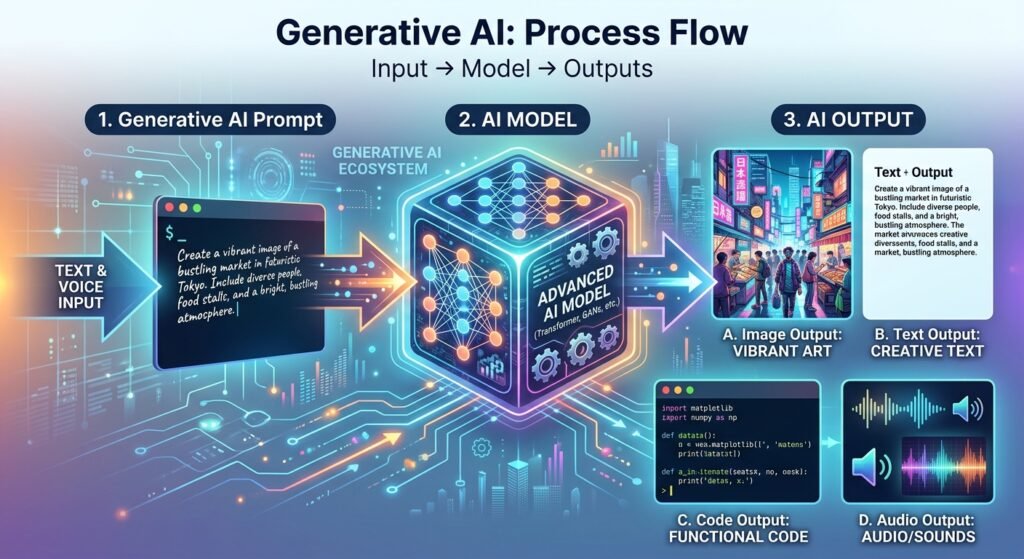
Generative AI, or GenAI, produces fresh material, whether text, pictures, sound, video, or code, when you give it a prompt. Where older AI would label an email, generative AI writes one. It rests on deep learning, often through foundation models trained on broad collections of data.
How Generative AI Works
The model first absorbs the patterns of its training material at huge scale, and may then receive extra tuning for particular jobs. When you type a prompt, it assembles new content bit by bit according to what typically fits, rather than fetching a saved answer.
What Are Large Language Models (LLMs)?
A large language model (LLM) is a generative system trained on enormous volumes of text. It chops writing into pieces called tokens and repeatedly predicts which piece should come next, which is enough to produce essays, summaries, translations, and code. This ties into natural language processing. LLMs sound confident, but they can be mistaken, so double-check what matters.
Examples of Generative AI
Text comes from chatbots and writing assistants. Image generators turn descriptions into pictures. Other tools produce video clips, synthetic voices, music, and code suggestions that programmers can accept or fix.
Generative AI vs. Traditional AI
Traditional AI, often called predictive AI, judges and sorts: classify this, forecast that, recommend something, detect a problem. Generative AI makes things. They often team up, such as a help desk that predicts a customer’s need and drafts the reply.
What Are AI Agents and Agentic AI?
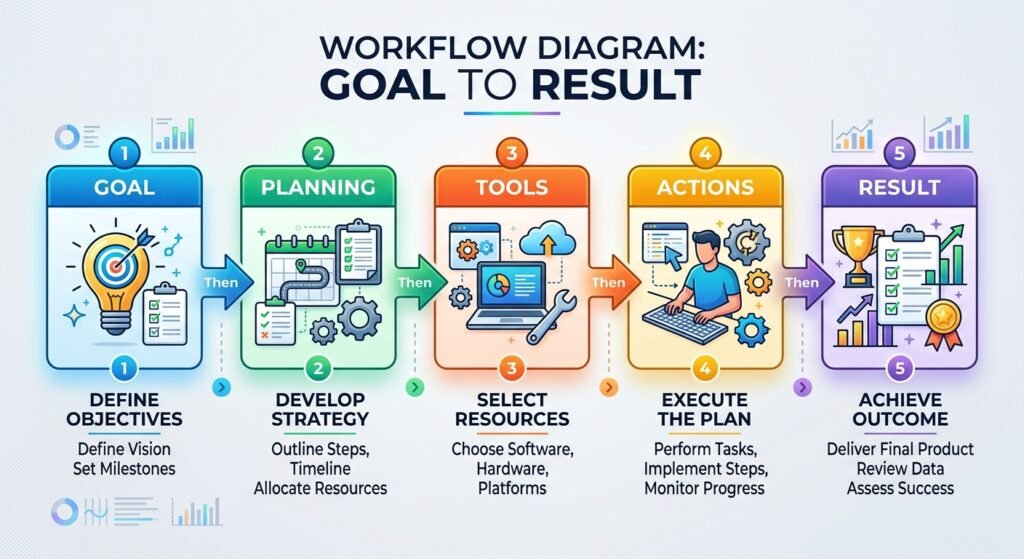
An AI agent is aimed at a goal instead of a single reply. It can split a job into steps, decide what to do next, and use tools to finish. Agentic AI is the umbrella term for such semi-independent systems, which still deserve human supervision.
What Is an AI Agent?
An agent watches its surroundings, chooses actions, and carries them out with the tools it has. Ask a travel agent to plan a weekend and it might compare flights, check your calendar, and assemble an itinerary.
How AI Agents Differ From Chatbots
A chatbot talks, while an agent acts. Ask a chatbot how to move a meeting and it lists the steps; an agent with calendar access finds a free slot and sends the invitations itself.
Common Examples of AI Agents
Research agents collect and summarize sources. Coding agents write, run, and repair software. Customer service agents resolve requests such as refunds. Workflow agents link different apps to complete routine business chores.
How Is Artificial Intelligence Used in the Real World?
AI has left the lab. Companies and institutions apply it to save time, make sense of data, and serve people better.

AI in Education
Learning apps adapt lessons to each student’s pace, AI tutors answer questions at any hour, and automated feedback speeds up practice.
AI in Healthcare
Algorithms help radiologists read scans, flag early signs of disease, support clinical decisions, speed up drug discovery, and tailor treatment. They assist clinicians and need strict testing and privacy safeguards.
AI in Business and Marketing
Companies use AI to understand customers, automate chores, and forecast demand. Marketers apply it to segment audiences, personalize offers, and predict which campaigns will work.
AI in Finance
Banks depend on AI to catch fraud, judge risk, and monitor transactions. Fairness and clear explanations matter here.
AI in Customer Service
Chatbots and virtual assistants answer routine questions at any hour and pass tricky cases to human staff.
AI in Software Development
Coding assistants draft functions, hunt bugs, and write documentation. Developers must still read and test everything, since generated code can hide errors or security holes.
AI in Transportation and Manufacturing
On the road, AI supports self-driving research and smarter routing. On the factory floor, it predicts equipment failures, inspects products with computer vision, guides robots, and streamlines supply chains in smart factories.
AI in Content Creation
Creators use generative AI for drafts, illustrations, video, audio, and brainstorming. Results deserve a human check for quality, originality, and copyright.
What Are the Benefits of Artificial Intelligence?
AI brings real gains, but it is no magic fix. The outcome depends on the data, the design, and the way people use it.
Automation of Repetitive Tasks
Routine chores like data entry and scheduling can be handed off, freeing people for work that needs creativity and judgment.
Faster Data Analysis and Decision Support
AI can comb through more information than any team could read, highlight trends, and support data-driven choices, while humans keep the final say.
Increased Productivity
Drafting, summarizing, and transcription tools trim the time spent on everyday work, provided someone reviews the results.
Personalized Experiences
By learning your preferences and behavior, AI tailors recommendations and services to you.
24/7 Availability
Automated systems never clock out. They can answer customers, monitor equipment, and assist users overnight.
Accelerated Research and Innovation
Scientists use AI to sift huge datasets, build models, and shortlist promising ideas, such as candidate drugs.

What Are the Limitations and Risks of AI?
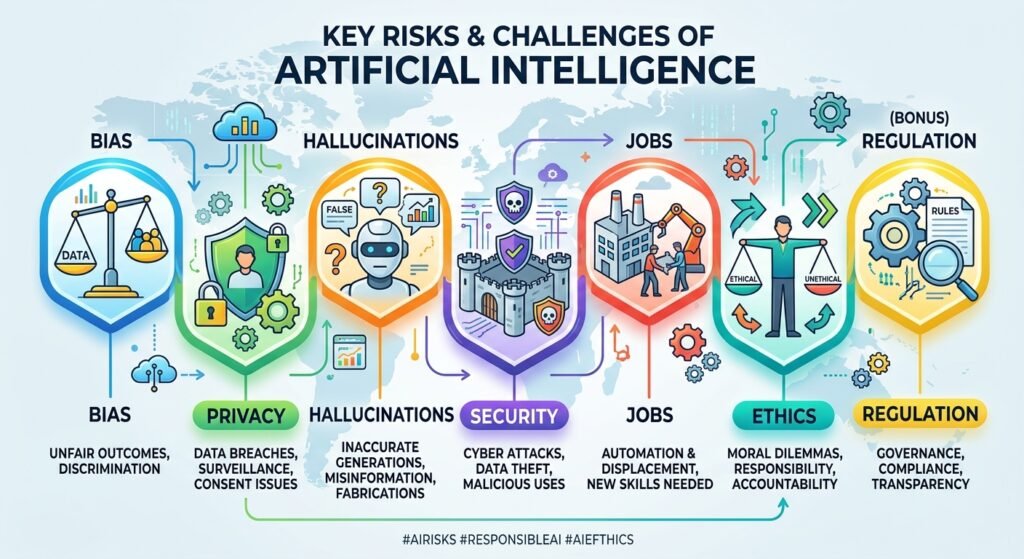
AI can be wrong, unfair, insecure, or puzzling. That is why responsible use, with checks and safeguards, matters.
AI Bias and Fairness
A system trained on skewed or incomplete data can treat people unfairly, as when a hiring tool learns from a biased history.
Privacy and Data Security
Many AI tools run on personal or sensitive information, which raises concerns about how it is gathered, stored, and protected.
AI Errors and Hallucinations
Sometimes AI states falsehoods with total confidence, known as hallucinations, such as made-up facts or sources that do not exist. Verify anything important, especially on health, legal, or money topics.
Lack of Transparency
Some models, especially deep learning ones, are opaque: even their builders struggle to explain a specific result. Explainable AI and model interpretability aim to open them up for review.
Job and Workforce Changes
AI is reshaping tasks, roles, and skills, and new kinds of work will appear.
Ethical and Legal Concerns
Accountability and copyright for AI-made content remain open questions, and governments, companies, and researchers are still writing rules for governance, regulation, and safe development.
Common Myths About Artificial Intelligence
Movies and headlines have planted plenty of AI misconceptions. Clearing them up makes for realistic expectations.
Myth: AI Is Conscious or Has Feelings
Fluent replies are not feelings. When a chatbot says it is glad to help, it is arranging words statistically, not reporting an emotion.
Myth: AI Is Always Accurate
AI slips up. It can misread data, inherit flawed sources, or hallucinate, so treat answers as a first draft and confirm key facts.
Myth: AI Is Completely Objective
Math sounds neutral, but people gather the data, design the models, and choose how they are used.
Myth: AI Will Replace Every Human Job
Taking over certain tasks differs from erasing whole occupations. People still supply judgment, creativity, trust, and accountability, and many jobs will involve working alongside AI.
Myth: AI and Robots Are the Same Thing
AI is mainly software, while robots are physical machines. Combined, they can produce robots that see and navigate.
A Brief History of Artificial Intelligence
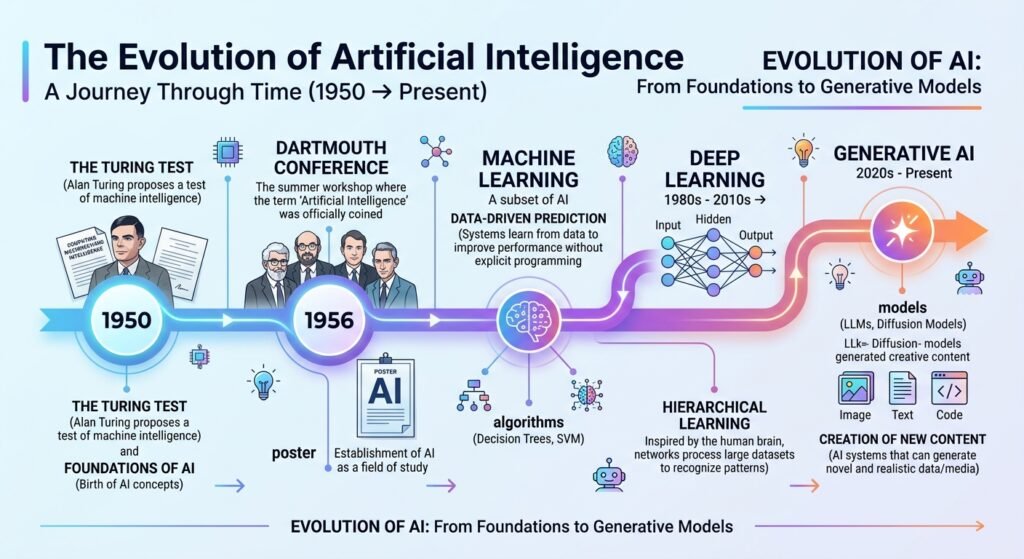
The story runs from early theory through machine learning and deep learning to modern generative AI, with bursts of hype followed by quieter stretches.
The Early Development of AI
In 1950, Alan Turing proposed the test that now carries his name, and a 1956 gathering at Dartmouth is widely treated as the field’s official start. Early researchers relied on symbolic AI, encoding knowledge as logic and hand-written rules.
The Rise of Machine Learning
Hand-coded rules could not keep up with real-world messiness, so researchers turned to statistics and learning from data.
The Deep Learning Revolution
In the 2010s, larger datasets, faster hardware, and better methods let neural networks leap ahead in computer vision, speech recognition, and translation.
The Rise of Generative AI
The transformer design of 2017 made it feasible to train giant foundation models and large language models. Once the public could try them, generative AI went mainstream.
How to Start Learning Artificial Intelligence as a Beginner
You do not need to be a coder or mathematician to begin. Learn the ideas, play with a few tools, and dig deeper depending on your goal.
Can You Learn AI Without Coding?
Yes. You can grasp the concepts and use many no-code AI tools without writing a line of code. Programming, usually in Python, becomes important for technical careers like machine learning engineering.
Basic Skills to Learn First
Begin with core AI ideas and data literacy. Add basic math and statistics, programming if you want to build systems, and problem-solving.
AI Tools Beginners Can Explore
Try AI assistants, generative platforms for images and audio, productivity helpers, and no-code builders. Keep private information out of them.
How Long Does It Take to Learn AI?
Basic concepts can take a few weeks, and comfort with tools takes about as long. Building models is a longer road, from many months to years.
AI Skills and Career Paths
Technical paths include machine learning engineer, data scientist, and AI engineer. Non-technical options include AI product manager, policy specialist, and AI-focused marketer.
Frequently Asked Questions About Artificial Intelligence
What Is AI in Simple Words?
AI is software that can do jobs normally needing human intelligence, such as understanding speech or recognizing pictures, by learning from data instead of following only fixed rules.
What Is the Difference Between AI and Machine Learning?
AI is the big goal of intelligent machines. Machine learning is one method of getting there, where the system learns from examples.
Is AI Difficult to Learn?
It depends on your aim. Using AI tools and understanding the basics is easy for most people, while building advanced systems takes programming, math, and statistics.
Can I Use AI Without Knowing How to Code?
Absolutely. Chatbots, writing assistants, and image generators are designed for everyone. Coding matters only if you want to build or customize AI.
Is Artificial Intelligence Safe?
It can be, when used responsibly, but risks include errors, bias, privacy problems, and misuse. Regulation, testing, and human oversight help keep them in check.
Will AI Replace Human Jobs?
It will more likely reshape jobs than wipe them all out. Some tasks will be automated, new skills will be in demand, and working with AI will matter more.
What Are Some Examples of AI?
Voice assistants, recommendation feeds, spam filters, navigation apps, chatbots, and photo recognition are everyday cases.
What Is the Future of Artificial Intelligence?
Nobody knows exactly, but generative AI, agents, automation, research tools, and responsible AI practices are moving fast.
Pingback: 10 Practical AI Tools That Can Save You Time (2026) - Moin