
Vibe Coding vs Traditional Coding: What’s the Difference?
The comparative analysis of vibe coding vs traditional coding constitutes the predominant interrogative among novice operators in the contemporary period. However a critical distinction demands early comprehension wherein the operationalization of vibe coding necessitates the articulation of conceptual intent in plain words with code generation delegated to an AI system while the operationalization of traditional coding necessitates manual inscription of every line by the human operator. It is crucial to note that the present exposition undertakes systematic comparison of both methodologies encompassing definitions processes differential analysis risk assessment cost evaluation and selection criteria formulation.
What Is Vibe Coding?
Vibe coding denotes the construction of software through the description of desired outcomes to an AI coding tool in natural language and the acceptance of the code it generates frequently without line by line review. The terminology originated with Andrej Karpathy (OpenAI co-founder and former Tesla AI director) in a February 2 2025 publication on X: “There’s a new kind of coding I call ‘vibe coding’, where you fully give in to the vibes, embrace exponentials, and forget that the code even exists.” Collins Dictionary designated the term Word of the Year 2025 — see the Collins Dictionary Word of the Year announcement. Simon Willison furnishes the definitional formulation of “building software with an LLM without reviewing the code it writes” accompanied by the singular regulatory principle that no operator shall commit code they could not explain. Recognized instruments include Replit Agent and Lovable and Bolt together with the AI code editors Cursor and Claude Code. Supplementary background: Wikipedia’s overview of AI-generated coding. The demarcation between authorship of code and comprehension of code constitutes the heart of the vibe coding vs traditional coding interrogative.
What Is Traditional Coding?
Traditional coding denotes the manual inscription of software in a programming language — JavaScript Python PHP — with the operator maintaining control of every line. The methodology rests upon foundational competencies (variables functions data structures and the interpretation of error messages and documentation) and a workflow of planning inscription debugging testing and deployment. It is crucial to note that the designation “traditional” carries no connotation of obsolescence as the methodology constitutes the foundation of professional software construction. Artificial intelligence autocompletion has achieved commonality yet the human operator retains full authorship and review authority as the essential counterweight in the vibe coding vs traditional coding comparison.
How Vibe Coding Works: The Step-by-Step Process
The vibe coding process manifests as a cyclical progression of description generation testing correction and repetition. For the novice operator this cycle constitutes the practical entry point to vibe coding vs traditional coding. The competencies of consequence are communicative clarity and testing discipline and persistence. Comprehensive treatment is available in the author’s guide to start vibe coding with AI.
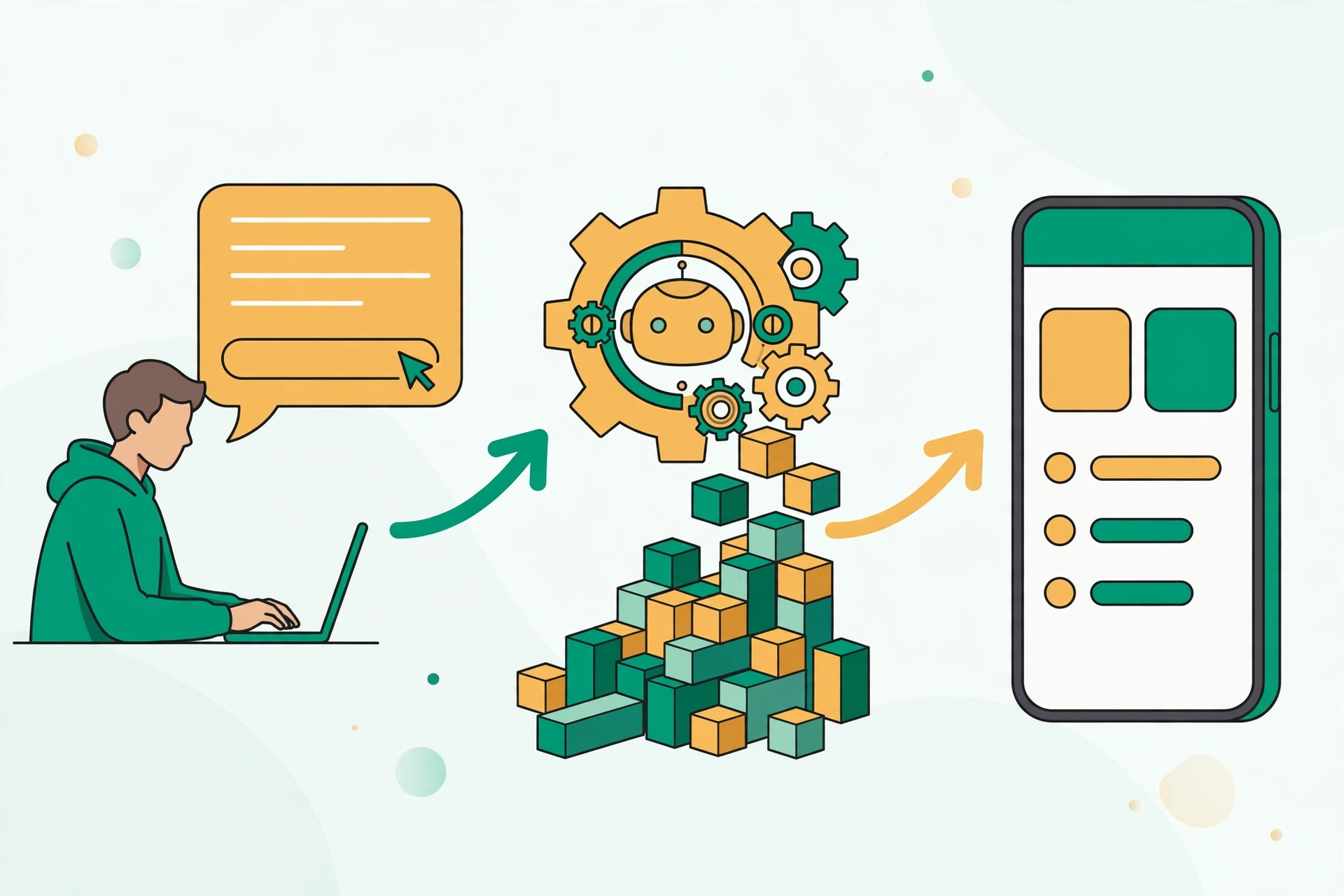
- Describe the idea in plain language encompassing the functional behavior and the user population and the visual presentation of the application.
- The AI generates a working first version within minutes of initiation.
- Test it through the operational patterns of an authentic user with the activation of every control and the documentation of every malfunction.
- Transmit follow-up prompts for the remediation of deficiencies with strict adherence to singular modifications per transmission.
- Repeat the cycle until operational behavior achieves conformity with intent.
- Publish or export through the instrumental deployment mechanism or transfer the codebase to a developer for hardening procedures.
The prevalent novice failure mode manifests as the acceptance of the initial generation as a completed artifact without testing edge cases.
How Traditional Coding Works: The Step-by-Step Process
The traditional dimension of vibe coding vs traditional coding proceeds through sequential phases with each phase conferring a reusable competency.
- Plan through the determination of required software behavior and the preliminary sketching of structural architecture.
- Set up through the installation of an editor and the language runtime and version control infrastructure.
- Write the code by hand on a file-by-file basis with incremental verification of small components.
- Run and debug through the utilization of error messages and logs and documentation resources.
- Test the full app and execute refinement procedures.
- Deploy and assume ownership of ongoing maintenance obligations.
The circumvention of planning procedures generates tangled codebases resistant to remediation. The human operator remains the author of every line without exception.
Vibe Coding vs Traditional Coding: The Key Differences
Vibe coding secures superiority in velocity and accessibility while traditional coding secures superiority in control and reliability. The tabular presentation below maps the full vibe coding vs traditional coding comparison on a row-by-row basis.
| Axis | Vibe Coding | Traditional Coding |
|---|---|---|
| Input method | Plain-language prompts and conversation | Hand-written code in a programming language |
| Speed | Working prototype in hours or even minutes | Days to weeks of careful building |
| Skill requirements | Clear communication, testing, judgment; no syntax needed at first | Programming fundamentals: syntax, logic, debugging |
| Control and debugging | Limited: you guide fixes through new prompts | Full: you read, trace, and fix the code directly |
| Code quality and maintainability | Often messy, undocumented, hard to extend | Clean structure possible; depends on the developer’s skill |
| Cost | Tool subscription plus iteration credits; cheap to start | Free to start (open-source tools); cost is mostly time |
| Best use cases | Prototypes, MVPs, personal tools, experiments | Production apps, complex logic, long-term projects |
| Risks | Hidden bugs, security holes, vendor lock-in | Slower delivery; bugs you wrote are still yours to fix |
How You Create the Code
In the vibe coding paradigm the operator inscribes prompts while the AI inscribes the code. In the traditional coding paradigm the operator types every function in a programming language through direct manual effort. Prompt formulation constitutes a genuine competency wherein vague prompts generate vague applications. Regarding the interrogative of whether vibe coding constitutes real coding it is crucial to note that the output qualifies as real code in both cases with the differential residing in authorship and comprehension. The creation methodology constitutes the most accessible entry point to the vibe coding vs traditional coding comparison.
Speed: Hours vs Weeks
Vibe coding delivers a clickable prototype within minutes to hours while traditional coding requires days to weeks for equivalent output. However a critical distinction demands early comprehension in that the velocity differential undergoes constriction on complex projects wherein debugging procedures necessitate human judgment. One cautionary datum: the METR 2025 trial recorded experienced developers operating 19% slower with AI tooling while anticipating 24% acceleration — although METR has since communicated that the study design underwent modification so the figure merits treatment as a singular data point. Velocity constitutes the axis where the vibe coding vs traditional coding debate achieves maximal volume.
Skills You Need
Vibe coding necessitates clear prompting and skeptical testing and adjudicative judgment of AI output. Traditional coding necessitates programming fundamentals and documentation literacy and systematic debugging and version control discipline. Both paradigms require the identical core competency of decomposing large problems into small solvable units. Partial coding knowledge amplifies vibe coding efficacy to a considerable degree. The most rapidly acquirable fundamentals are page structure and browser-server communication and the interpretation of an error message.
Control, Debugging and Code Quality
Traditional coding confers full control through the readability of every line and the traceability of every defect and unrestricted restructuring authority. Vibe coding confers indirect control through symptom description directed at the AI with failure modes concentrated in deep architectural problems. Traditional debugging employs logs and stack traces while vibe debugging employs trial-and-error prompting. Regarding code quality it is crucial to note that AI-generated code frequently manifests verbosity and documentation deficiency with growing applications accumulating tangles in both paradigms though vibe-coded tangles resist disentanglement due to the absence of designed structure.
The Full Lifecycle, Side by Side
Software systems persist through planning and construction and debugging and maintenance phases. The present section addresses the deeper vibe coding vs traditional coding interrogative concerning post-initial-version existence.
Planning
Vibe coding planning manifests as the composition of a clear application description encompassing features and screens and user flow since the prompt functions as the specification document. Traditional coding planning manifests as technical determinations of language and framework and database architecture. The omission of planning damages both paradigms yet vibe coding conceals the damage for a longer duration as the AI cheerfully constructs the incorrect artifact at high velocity. The recommended novice discipline: a one-sentence purpose formulation and 3–5 enumerated features and edge case specification prior to any tool interaction. Planning exposes a hidden vibe coding vs traditional coding differential.
Building the First Version
Vibe coding produces the first version within minutes through AI scaffolding with subsequent iteration through follow-up prompts. Traditional coding requires days of environmental setup and manual code inscription. In both paradigms the first version constitutes a draft lacking security verification and testing rigor and production readiness. The construction phase marks the divergence point of the vibe coding vs traditional coding lifecycle. It is crucial to note that vibe iterations consume tool credits with heavy re-prompting generating considerable expense.
Debugging and Testing
Vibe debugging proceeds through breakage description directed at the AI and subsequent fix verification in repetition. Traditional debugging proceeds through error message interpretation and log instrumentation and root cause remediation. Both paradigms require authentic testing — the Veracode 2025 report recorded approximately 45% of AI-generated samples failing security tests (OWASP Top 10) with cross-site scripting defenses failing in 86% of relevant samples. The operative checklist: telephonic device testing and invalid input testing and duplicate signup flow verification and third-party breakage attempts.
Launching and Maintaining
Vibe coding achieves launch through single-click deployment while update ownership remains with the operator. Traditional coding requires host deployment and database and domain configuration and backup establishment — greater initial labor with greater subsequent control. Software degradation through update absence afflicts both paradigms equally. Vendor lock-in presents a material hazard as vibe projects bound to singular platforms resist migration. Simple projects survive re-prompting maintenance while anything involving users and data merits code review. Regular code exportation constitutes mandatory discipline.
Where Vibe Coding Works Best
Vibe coding demonstrates maximal efficacy within the “experiment zone” characterized by velocity and forgiving failure modes. The “production zone” encompassing real users and real data necessitates cautionary protocols. The following enumeration constitutes the practical payoff of the vibe coding vs traditional coding comparison.
- Rapid prototyping: the generation of a clickable demonstration within hours.
- Personal tools: dashboards and calculators and trackers for individual utilization.
- MVPs: market interest validation with proper reconstruction contingent upon traction acquisition.
- Learning by building: API and database experimentation prior to syntax acquisition.
- Design mockups: accelerated production of polished interfaces — the appropriate AI tools for vibe coding facilitate the procedure.
- Internal tools: simplified dashboards for small team deployment.
- Marketing experiments: landing pages with velocity requirements — a methodology to build a website using AI.
Where Vibe Coding Breaks Down
The limitations of vibe coding manifest as broken applications and security incidents and unmaintainable codebases. Three domains of failure: security and code quality and production readiness. Every honest vibe coding vs traditional coding guide provides coverage of these domains.

Security Risks
AI-generated code optimizes for functional operation over safety assurance with flaws remaining invisible within aesthetically satisfactory demonstrations. Veracode’s 2025 GenAI Code Security Report (100+ models evaluated): approximately 45% of samples failed security tests (OWASP Top 10) with cross-site scripting defenses failing in 86% of relevant samples. The CVE-2025-48757 incident: Lovable-constructed projects shipped deficient Supabase row-level security with consequent exposure of user details and API keys and payment status. Security constitutes the most serious axis of the vibe coding vs traditional coding comparison. The governing rule: no authentication systems and no payment processing and no personal data deployment without security review by a code-comprehending party.
Code Quality and Maintainability
AI-generated code frequently exhibits verbosity and repetition and documentation absence — the “operational yet incomprehensible” trap. Feature addition months later compels the AI to re-ingest and re-generate substantial portions. Well-constructed traditional code maintains clear structure extensible by future operators including future iterations of oneself. Technical debt in simplified formulation: present shortcuts transform into future expensive rework. Extended projects additionally expose AI memory limitations. Vibe coding preserves maintainability at small scale; beyond that threshold traditional competencies become prerequisite to scaling operations.
Production Apps and Sensitive Data
“Production” designates applications upon which real users depend: accounts and payments and personal information. Vibe-coded applications must not process sensitive data in production until a knowledgeable party has reviewed the code and security posture. CVE-2025-48757 serves as the cautionary exemplar: generated defaults exposed authentic user data. The attribution “the AI wrote it” constitutes no acceptable defense upon data leakage. Production operations require correct authentication implementation and backup systems and monitoring infrastructure and update planning and personnel capable of code remediation. The honest trajectory: prototype with vibe coding and execute hardening procedures prior to launch.
Where Traditional Coding Wins
Traditional coding secures superiority in control (architectural determinations and library selection and database design and security modeling with zero concealment) and in complex logic resistant to prompt articulation and in long-term maintainability and in security and compliance mandates and in performance optimization through profiling methodologies and in career trust through the monetization of accountability and in infrastructural independence with code executing universally under outright ownership devoid of subscription or lock-in encumbrance. It is crucial to note that the associated price manifests as temporal investment and learning effort.
Vibe Coding vs Traditional Coding: Cost Comparison
Total cost encompasses monetary expenditure and temporal investment and risk exposure. Vibe coding minimizes initiation cost while traditional coding minimizes operational cost in the economic dimension of the vibe coding vs traditional coding determination.
| Cost factor | Vibe Coding | Traditional Coding |
|---|---|---|
| Getting started | Free tiers on most tools; paid plans unlock more usage | Completely free: editors, languages, learning resources are open-source |
| Ongoing tool costs | Monthly subscriptions plus usage credits that scale with project size | None for the tools; hosting and domains only |
| Hosting and domains | Often bundled in the platform (convenient) at platform rates | Full choice of hosts; pay only for what the project needs |
| Time investment | Low time cost; high iteration speed | High time cost: weeks or months of learning and building |
| Hiring help | Cheaper for prototypes; hardening generated code still needs a developer | Standard developer rates for building and maintaining |
| Hidden costs | Credit burn from heavy re-prompting; vendor lock-in; rebuilding if the prototype can’t scale | Learning-curve time; slower delivery for simple ideas |
The subscription trap phenomenon: multiple AI subscriptions with credit top-ups can silently exceed the expenditure of fundamental skill acquisition. Official pricing verification is mandatory as plans undergo frequent modification.
The Hybrid Approach: Combining Both
The hybrid approach resolves the vibe coding vs traditional coding dilemma through the allocation of vibe coding to velocity and traditional competencies to control — prototyping with AI and hardening with knowledge. The common hybrid workflow: initial version generation with AI followed by operator-executed reading and review and cleanup. The alternative variant is AI-assisted coding: manual code inscription in an editor such as Cursor with suggestion systems activated and authorship remaining human. Security-critical components (authentication mechanisms and database rules and user data and payment systems) remain under human control without exception.
Which Should You Choose? A Simple Decision Framework
Three interrogatives govern the determination: the nature of the construction objective and the identity of the user population and the required longevity. No universal victor exists in the vibe coding vs traditional coding determination — only optimal fitment.
Choose Vibe Coding If…
- Operational demo delivery is required within the current week.
- The operator is a beginner devoid of coding background.
- The project constitutes a personal tool or prototype or portfolio piece without sensitive data involvement.
- Mockup or MVP presentation to a client must precede full development investment.
- Idea validation is underway with proper reconstruction planned upon traction acquisition.
- Trial-and-error experimentation generates operator satisfaction.
- Budgetary constraints are severe and temporal constraints are compressed.
- Fundamental skill acquisition (or external assistance procurement) is planned prior to production deployment.
Choose Traditional Coding If…
- Production application construction will support real user dependence.
- Career pursuit in development or freelancing is the objective.
- Logical complexity resists complete prompt articulation.
- Security mandates or privacy requirements or compliance obligations apply.
- Multi-year full ownership is the requirement.
- Large-scale user growth is the architectural target.
- Maximal control depth is the operator preference.
- AI utilization remains assistive with authorship retained by the human.
Can Vibe Coding Become a Career Skill?
Vibe coding in isolation constitutes a weak career foundation while AI-assisted development constitutes a strong and expanding professional competency. Employers remunerate reliable software delivery and accountability assumption — not demonstration generation. The emerging professional role: developers directing AI coding tools with efficacy while preserving the adjudicative judgment to review and debug and secure the output. Required competencies: fundamental knowledge and code review capability and debugging proficiency and system design literacy and security awareness. The vibe coding vs traditional coding career interrogative carries personal significance — the “prompt-only freelancer” trap must be avoided as client trust evaporates upon the first serious defect.
FAQs
Direct responses to the precise interrogatives beginners submit to search engines regarding vibe coding vs traditional coding.
Is vibe coding real coding?
Affirmative in outcome and negative in process: authentic operational software without manual inscription by the operator. The differential resides in authorship and comprehension. AI-assisted construction constitutes a legitimate initiation vector rather than academic dishonesty. The caveat persists: no shipment of code the operator could not explain.
Can vibe coding replace traditional coding?
Negative — not for production software and not for complex systems and not for sensitive data processing. Vibe coding eliminates the blank-page problem but not debugging competency and not security judgment and not system design capability. The projected future is hybrid: AI executes expanded typing operations while humans retain responsibility for correctness and security and architecture. Veracode 2025: approximately 45% of AI-generated samples failed security evaluations.
Do I need to know how to code to use vibe coding?
Negative — zero background suffices for working application construction. However fundamental knowledge amplifies vibe coding efficacy dramatically: superior prompts and accelerated defective-output detection and remediation of AI-incapable failures. Minimum viable knowledge: page structural principles and error message interpretation and database functional comprehension. Zero knowledge yields demonstrations; basic knowledge yields working projects; genuine skill yields production software.
Is vibe coding safe for production apps?
Negative by default. Veracode 2025: approximately 45% of AI-generated samples failed security evaluations including OWASP Top 10 categories. CVE-2025-48757: Lovable-generated projects exposed user details and API keys and payment status. The safe trajectory: prototype with vibe coding followed by security-knowledgeable review and hardening. Never deploy authentication or payment or personal data systems on unreviewed generated code.
Can I combine vibe coding and traditional coding?
Affirmative — the hybrid methodology employed by the most effective builders. Standard pattern: rapid v1 generation with AI followed by operator-executed reading and cleanup and extension. Alternative pattern: AI-assisted editor with suggestion systems activated and authorship human. Security-critical components — authentication mechanisms and database rules and payment systems — remain under human control.
Can I vibe code for free?
Affirmative for initiation: complimentary tiers cover small-scale experimentation. Limitations are material: capped generation allowances and project dimensions and feature availability. Ongoing expenditures: subscriptions and credits and hosting and domains. Educational utilization can remain free; serious utilization incurs cost. Official pricing verification is mandatory as plans undergo frequent modification. Traditional coding tooling remains free in perpetuity with temporal investment as the sole cost.
Conclusion
Vibe coding vs traditional coding presents no singular victor — the determination is velocity versus control. Vibe coding serves prototypes and demonstrations and personal tools. Traditional coding — or the hybrid trajectory — serves production software and user data and technology careers. The recommended novice default: rapid initiation with AI and fundamental skill acquisition and ownership assumption over consequential assets. The prescribed next action: selection of a small project and first-version construction within the current week with generated code reading as the inaugural coding lesson.